Introduction
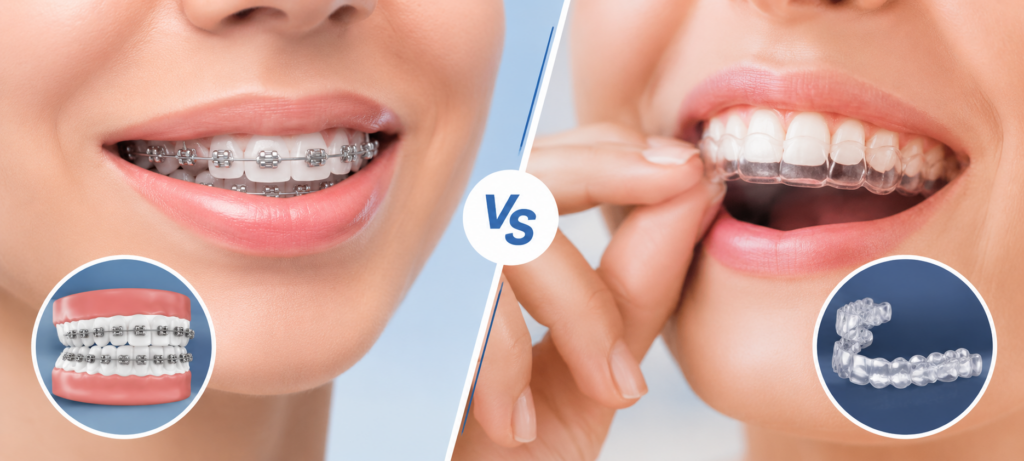
Difference between braces and aligners is one of the most common things patients want to understand before starting teeth alignment treatment. Choosing between braces and aligners usually depends on both lifestyle preferences and clinical needs. For most people, this decision starts when they think, “I need to correct my teeth, but I am not sure which option is right for me.
“I need to correct my teeth, but I am not sure how…”
Some individuals have no problem with the idea of wearing braces for a brief period. They might prefer the traditional method, even though there is another option that is less noticeable and more convenient.
Others prefer to use aligners. The question arises: braces vs aligners, which option is more effective?
Both methods are equally efficient in correcting the patient’s dentition. However, they differ in their approach, feel different, and are suitable for different patients.
Understanding this difference is essential since it helps clarify some issues, namely:
How does wearing aligners and braces affect everyday activities? Does it hurt? How long will it take to achieve the desired results?
Difference between braces and aligners
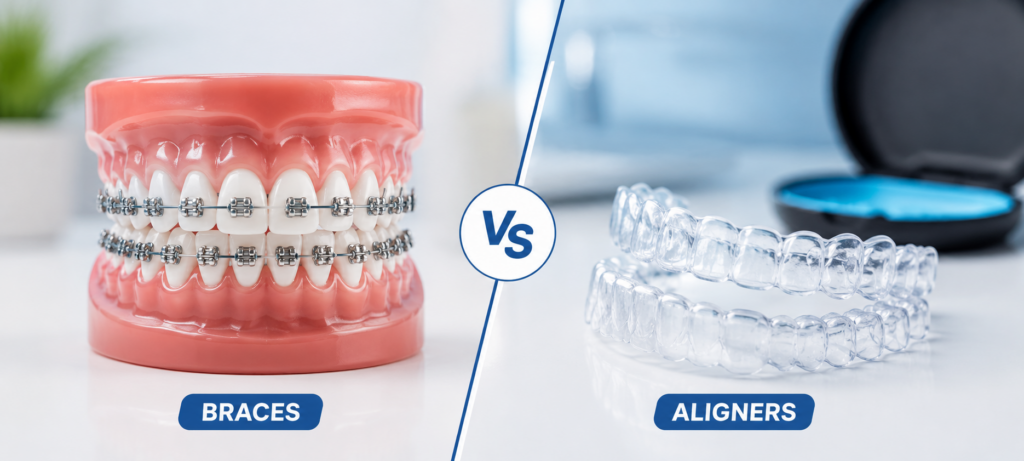
At a basic level, both braces and aligners are designed to do the same thing, move your teeth into better alignment.
But the way they do it is very different.
| Braces | Aligners |
| Fixed on your teeth | Removable transparent trays |
| Use brackets and wires | Custom-made for your teeth |
| Adjusted periodically by your dentist | Changed every few weeks |
| Fixed and work continuously | Aligners are removable and work when worn consistently |
How teeth aligners work ?
Most people think aligners just “push” teeth into place but it’s actually more precise than that.
Process
- A digital scan of your teeth is taken
- A treatment plan is created showing gradual movement
- A series of aligners is designed
- Each aligner shifts your teeth slightly
This continues for around 1 to 2 weeks at a time until you advance to the next set.
The cumulative effect of these minor adjustments brings about change.
How do braces work?
Braces use a completely different approach.
- Brackets are attached to your teeth
- A wire connects them
- The wire applies continuous pressure
Your dentist adjusts the wire periodically to guide movement.
This constant pressure allows braces to handle even more complex corrections.
Are aligners better than braces?
This is probably the most common question.
Here’s the thing: “better” depends on what fits better in your current lifestyle .
Aligners may feel better if you want:
- A more discreet appearance
- The flexibility to remove them
- Fewer food restrictions
Braces may be better if you need:
- Correction of complex alignment issues
- Strong, continuous force
- Reduced patient cooperation
- Reduced patient cooperationg the best option, but rather:
What will be the best for you and your teeth!
Which is the fastest orthodontic treatment?
Some patients might want the treatment to be done fast, and that is completely fine
But speed depends on the complexity of your case, not just the type of treatment.
Aligners
- Can be faster for mild to moderate cases
- Depends heavily on wearing them consistently
Braces
- Often preferred for complex cases
- May take longer but offer more control
In simple terms:
- Simple cases → aligners may be quicker
- Complex cases → braces may be more effective
Cost comparison: Difference between Braces and Aligners
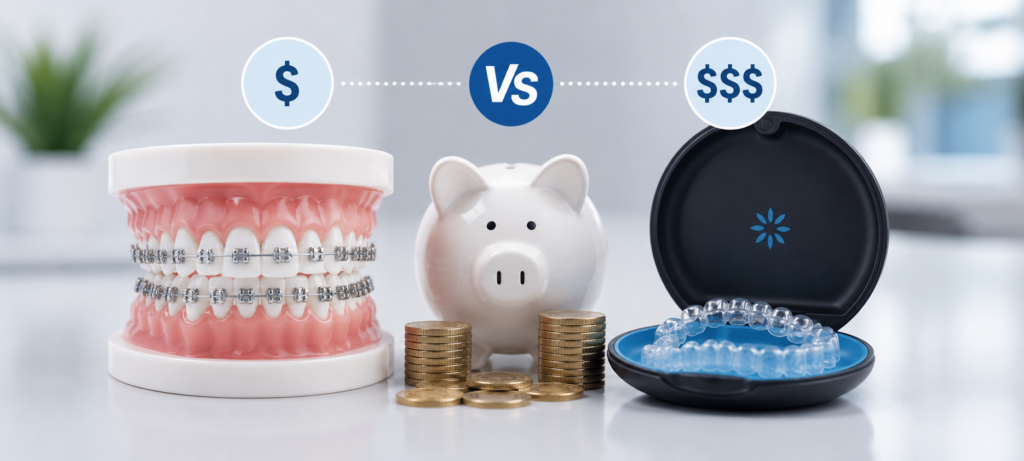
Let’s talk about something practical – the cost.
Braces cost on an average in India – Depending on the type 30,000 to 90,000 Rs
Aligners cost on an average in India – Depending on the case complexity 50,000 to 3,00,000 Rs
Why aligners cost more?
- Custom manufacturing
- Digital planning
- Advanced materials
But they also offer convenience and aesthetics that many patients value.
Are aligners better?
Depends on your lifestyle :Lifestyle differences you should consider
This is where the real decision often happens, not in the clinic, but in your daily life
With braces
- Fixed in place
- Food restrictions (avoid sticky/hard foods)
- More frequent adjustments
With aligners
- Removable while eating
- Easier brushing and flossing
- Requires discipline (20–22 hours wear daily)
So the question becomes:
Do you prefer structure, or flexibility?
The answer to this question defines what fits into your lifestyle.
Who should choose braces and who should choose aligners?
This is where things get clearer.
Braces are better for:
- Severe misalignment
- Complex bite issues
- Patients who may forget to wear aligners
Aligners are better for:
- Mild to moderate alignment issues
- Adults and working professionals
- People who prefer a discreet option
Your orthodontist will guide you based on:
- Your teeth condition
- Your lifestyle
- Your expectations
But, here’s something important.
As aligners become more popular, many unqualified providers have started offering them.
Orthodontic treatment involves precise and controlled tooth movement. So it’s important that your treatment is guided by a trained orthodontist.Choosing the right expert matters just as much as choosing the right treatment.
Conclusion
If you’ve been going back and forth between braces and aligners, that confusion is completely normal. Both options are designed to do the same thing,but they fit into your life very differently.
Some people prefer the predictability of braces. Others feel more comfortable with the flexibility aligners offer. But this does not have to apply to everyone. In fact, it is quite helpful, because this will ensure that the treatment plan will suit you specifically.
The main task, however, is not to decide whether braces or aligners are better when compared but to understand which way would be most suitable for you, taking into account the peculiarities of your teeth, schedule, etc. With all this clear, making a choice is much easier. Ultimately, the result remains the same: a healthy set of aligned teeth.
Book your appointment and unleash your perfectly aligned smile