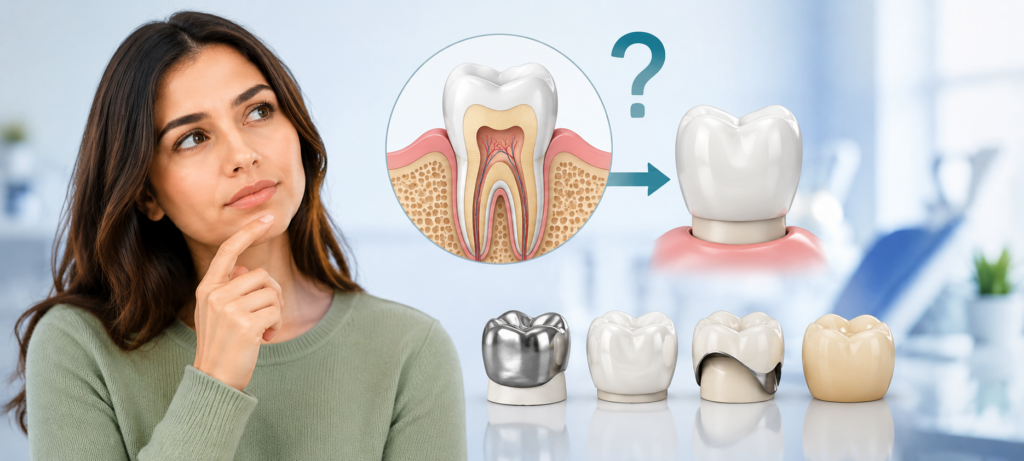
After a root canal, One thing is very important to be answered is does the root canal treated tooth require a crown? Another question that usually immediately follows: Why are there many types of dental crowns available? Which type suits me? We will try to provide an answer to this question in this post.
A tooth is weakened after a root canal treatment and while aesthetics are a very important consideration when selecting your crown, function still tops the priority. Putting a crown over the tooth will not only give the tooth a natural look but will also be a kind of protective cover for the tooth that will enable its normal use.
Is crown necessary after root canal?

It usually happens that when a person’s pain from a root canal disappears, he/she assumes that the whole root canal procedure has been completed. But the truth is other way around,
After a root canal:
- Infection is extracted from the tooth.
- The tooth is treated and sealed.
- However, the structure of the tooth is weakened.
So, in most cases, we dentists advise getting a crown.
Without a crown, the tooth is highly prone to:
- Crack under chewing pressure
- Wear down faster
- Eventually fail
You might not notice it immediately, but over time, a cracked tooth after root canal is a very real risk.
When you might “NOT” need a crown?

Nonetheless, there are exceptional cases in which a crown may not be needed, including:
- Front teeth (as less pressure is applied when chewing)
- Little to no damage done to the tooth
In these situations, depending on your individual situation, your dentist will counsel you how to proceed. With this being said, the answer to your question is: the majority of time, a root canal procedure will require a dental crown.
Types of dental crowns
After comprehending the reasons why crowns are required, let us now take a look at various kinds of crowns.
1. Metal crowns
These are made from metal alloys and are known for their strength.
Best for: Back teeth (molars)
Advantages:
- Extremely durable
- Long-lasting
- Less chance of chipping
Limitations:
- Metallic appearance
- Not suitable for visible areas
2. All ceramic crowns
These are tooth alike and blend well with natural teeth.
Best for: Front teeth
Advantages:
- Excellent aesthetics
- Natural appearance
- Biocompatible
Limitations:
- Slightly less strong than metal for heavy chewing areas
3. Metal ceramic or PFM
Also called porcelain fused to metal crowns, a powerful combination of strength and aesthetics.
Best for: Both front and back teeth
Advantages:
- Strong metal base
- Tooth-colored outer layer
- Balanced performance
Limitations:
- May show a metal line over time
- Slightly less inferior than full ceramic crowns in terms of aesthetics.
4. Zirconium crowns
One of the most popular and to go options because of its superior qualities over others.
Best for: Both strength and aesthetics
Advantages:
- Very strong
- Tooth-colored
- Long-lasting
- Suitable for both front and back teeth
Most probable options
For front teeth
- Ceramic crowns are usually preferred
- They match your natural teeth perfectly
For back teeth
- Metal or zirconium crowns are often recommended
- They handle chewing pressure better
So it’s not about one being “better” over the other
It’s about choosing what works best for your tooth.
How does one decide which crown is better over other options?
Your dentist usually considers:
1. Tooth position
- Front → appearance matters
- Back → strength matters
2. Chewing pressure
Teeth that take more load need stronger materials.
3. Visibility while smiling
If the tooth is visible, aesthetics become important.
4. Budget consideration
Different materials come at different costs.
The aim is to select a crown that will effectively protect your tooth but suit your requirements.
How long does a crown for your tooth last?
This is one question that most patients do ask and it is very significant.
On average:
- Dental crowns last 10–15 years or longer
Although their lifespan depends on:
- Oral hygiene
- Biting habits
- Regular follow up visits
With crown placed accurately and proper post placement care, your crown can serve you for years with no problems.
What can one expect after a crown placement procedure?
Getting a crown is usually a smooth process.
After placement:
- Mild sensitivity for a few days is normal
- Your bite may need minor adjustment
- It soon feels just like a natural tooth
Most patients adapt very quickly.
How to take care of your crown?
Caring for a crown is simple but important.
- Brush twice daily
- Floss regularly
- Avoid biting very hard objects
- Routine follow up visits.
Remember, the crown protects the tooth but the surrounding area still needs care
Here’s where most people go wrong:
- Delaying the crown after RCT
- Choosing only based on cost
- Ignoring minor discomfort
They say “A stitch in time saves nine”and that’s exactly how crowns work when done at the right time.
FAQ
1. Is the placement of a crown after one visit RCT necessary?
In almost all cases, the dentist advises a crown. It will help the tooth remain protected from any fractures and work fine in the future.
2. Can you list some types of dental crowns available?
These include the following types:
1. Metal crowns
2. Ceramic crowns
3. PFM crown
4. Zirconium crowns
3. If given an option, which should I choose: ceramic crown vs metal crown?
Ceramic crown if the crown is to be placed on the front teeth, hence aesthetic considerations will be involved. Metal crown if it is to be placed on back teeth. It is best that you consult your dentist regarding this, as metal crowns are mostly avoided.
4. Metal ceramic crown vs Zirconia, which is the go to option?
Depends on the area to be placed, where the former is the foundation material whereas the latter is for aesthetics. Zirconia crowns do not have any metal. Therefore, zirconia crowns all the way, if clinically indicated.
5. For how many years can a dental crown serve?
With proper care, a dental crown can last 10–15 years or even longer.
Conclusion
It is absolutely natural to be in doubt about the necessity of the crown following a root canal treatment. However, once you know why it is needed, everything gets easier. The fact is, a crown is not an additional procedure , it is exactly the element that will allow your tooth to survive. Luckily, there are many kinds of dental crowns nowadays and you can choose the one that suits you most. Thus, a crown is not just something you put on your tooth, it is the last and most important layer of protection post RCT.

Dr. Chandni
B.D.S and M.D.S graduate